
On Friday, September 12, 2025, the sixth annual international symposium “Democracy in the 21st Century” took place at Pražská křižovatka, this time with the subtitle “Freedom and Innovation in the Technological Age.”
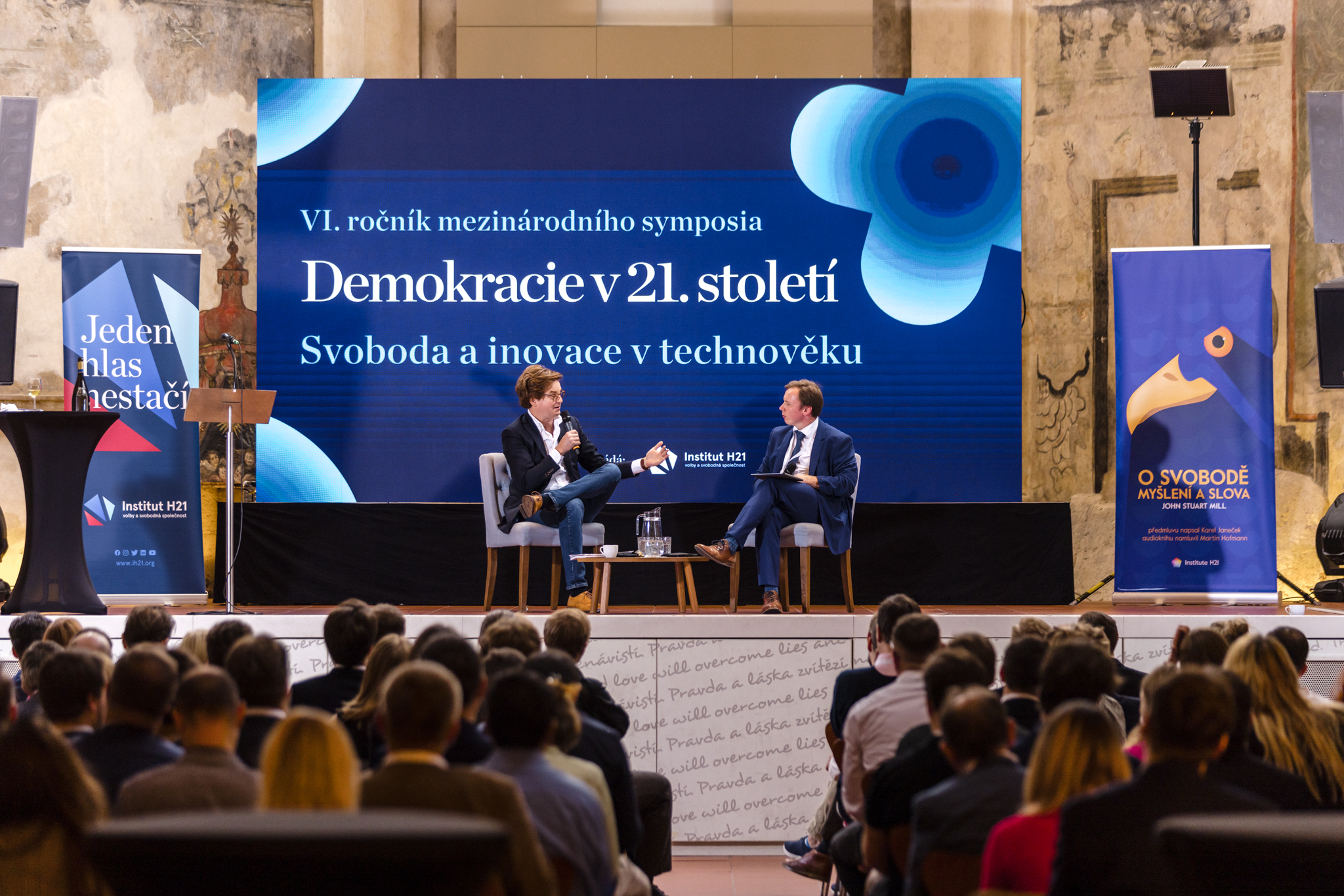
The all-day program brought together Czech and international experts in the fields of law, political science, technology, artificial intelligence research, and civil society in Prague. The common theme was the question of how new technologies, growing polarization, and shifts in public discourse are affecting freedom, democratic institutions, and the way society makes political decisions. Speakers included, for example, American lawyer and professor Jonathan Turley, freedom of speech expert Natalie Alkiviadou, law professor Eric Heinze, political scientist Mahendra Prasad, Palantir representative Nicholas W. Zamiska, technology and geopolitics researcher Moritz von Knebel, and Karel Janeček, founder of the H21 Institute.
The program addressed a range of current topics: from freedom of speech and the limits of hate speech regulation, to the role of technology and artificial intelligence in society, to ways of seeking broader social consensus in a polarized era.
The symposium also included a debate on electoral systems and the D21 method as a tool that can contribute to more moderate and consensus-based decision-making. If you were unable to attend the symposium or would like to revisit some of the presentations, we have the complete recordings available for you below:
Eric Heinze: What should “progressive” mean in the 21st century?
Mahendra Prasad: Choice Under Existential Risk and Goal Uncertainty
Karel Janeček: From Polarization to Moderation: Voting by Consensus with D21
Nicholas W. Zamiska: The Technological Republic: Hard Power, Soft Belief, and the Future of the West
Natalie Alkiviadou: Hate speech/free speech and the European Court of Human Rights
Jonathan Turley: The Indispensable Right: Free Speech in an Age of Rage?
We would like to thank all the speakers, partners, and participants who created an open space for a substantive discussion about the challenges facing democracy in the technological age.
Institute H21 will continue to explore these topics through research, public debates, publications, and other projects focused on freedom, democracy, and innovation.

We study electoral systems, the development of the D21 – Janeček Method, and issues of democracy.
About us


Copyright © 2022 Institute H21 z.ú. - All rights reserved.
Design and website created by Pavel Švejda
